
Is Hair Colour Shampoo Safe? What's Actually in the Bottle
16 Aug 2026
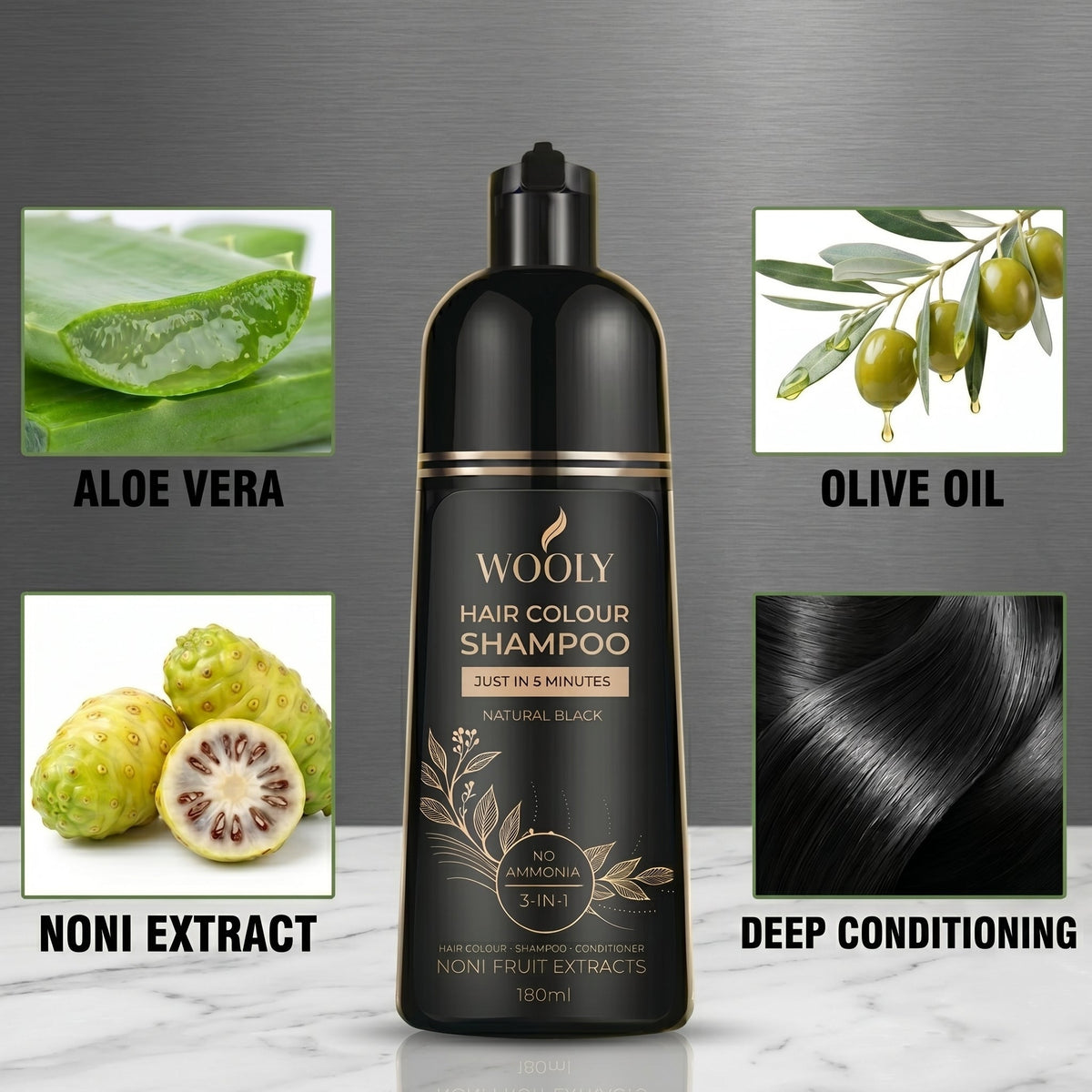
For most people, yes, as long as you patch test first. Wooly Hair Colour Shampoo contains PPD, a colourant active found in many permanent hair dyes, and PPD can cause allergic reactions. Test it on your skin 48 hours before first use. If you react, or already know you are allergic to hair dye, don't use it.
Here is what the key ingredients in hair colour shampoo actually do, and how to decide whether regular use is safe for you specifically.
The one ingredient worth understanding: PPD
Para-phenylenediamine, almost always listed as p-Phenylenediamine or PPD on the label, is the small molecule that does the actual colouring work in most permanent and semi-permanent hair dyes. It penetrates the hair shaft and oxidises to form larger colour molecules that get trapped inside. That is why the colour holds rather than washing straight out.
PPD is effective, which is why it appears in the majority of home colour products and salon formulas. It is also the hair-dye ingredient most often linked to allergic reactions (FDA). Many permanent and some semi-permanent dyes contain it (NHS).
Why PPD allergies catch people off guard
The tricky thing about PPD sensitivity is that it can develop at any point. You might use a colour product for five or eight years with no reaction, and then one day your scalp swells or your ears itch. Immune sensitisation to PPD can build up over repeated exposures, so a first use with no reaction does not rule out a reaction later. Once you are sensitised, the allergy is likely to be lifelong (DermNet).
A reaction can look like redness, itching, or a burning sensation at the hairline, behind the ears, or on the neck. In more serious cases, the swelling extends beyond the scalp. This is not rare. PPD is one of the most common causes of allergic reaction to hair dye (FDA).
How to read an ingredient list without a chemistry degree
INCI names (the standardised ingredient names used on cosmetic labels) are listed in descending order by concentration. The first five or six names tell you most of what you need to know about a formula's base. Look for:
- p-Phenylenediamine — if it is present, it will be listed. Note where it falls in the order.
- Resorcinol — another common colour coupler that can cause skin irritation and is worth knowing about.
- Hydrogen Peroxide — the oxidising agent that activates colour chemistry. Its concentration affects how harsh the formula is on hair.
- Conditioning agents — ingredients like hydrolysed proteins or silicones listed near the end indicate the formula is designed to reduce dryness during the colour process.
If a product skips PPD entirely, the label will typically name the substitute — HC Red, Basic Brown, or similar synthetic dye names.
How to do a patch test properly
Apply a small amount of the mixed product to the skin behind your ear or on your inner elbow. Leave it uncovered for 48 hours. Do not wash it off early. A reaction — itching, redness, swelling, or blistering — means do not use the product on your scalp.
No reaction after 48 hours is a reasonable sign you can proceed. It is not a guarantee. Sensitivity can develop with future uses, which is why a patch test before each new application is worth the two days of waiting (FDA).
The bottom line
"Safe" is not a fixed property of any bottle. It depends on the specific formula, your individual skin chemistry, and how frequently you use it. The honest answer is: check for PPD on the label, do a patch test 48 hours before every application, and pay attention to how your scalp feels during and after. If you want to understand how other aspects of hair colour chemistry — like ammonia — fit into the picture, this post covers that in detail. An "ammonia-free" line on the pack does not answer any of that — our ammonia-free hair colour guide explains what the claim does and does not cover.
Sources
- US Food and Drug Administration. Hair Dyes.
- NHS. Hair dye reactions.
- DermNet. Paraphenylenediamine and hair dye contact allergy.
Wooly Hair Colour Shampoo is ammonia-free, made for Indian hair, and covers grey in one wash. Learn more and shop here →